For the past few weeks our clients have been asking the same question: why did my Business Profile drop in Google Maps when nobody touched it? We went through Google's announcements, industry news sites and what local SEO specialists are reporting. Below you will find what has been confirmed, what is still only a hypothesis, and what is worth doing with your profile now. This article reflects the situation as of 12 November 2026.
Key points
- On 10 November 2026 Google started rolling out the November core update. It is the only algorithm change Google officially announced in this period.
- In late October some specialists noticed that Business Profiles in Maps were showing up across a smaller area than before. Google has not commented on this.
- Separately, the profile itself is changing. The Questions and answers section is going away, an AI agent is being added to messaging, and some profile settings can now be managed from Gemini.
- Sempuls data from the Polish market shows no smaller reach in Maps. It does show that since 23-26 September search impressions of Business Profiles have dropped by more than 80%, while the number of customer contacts has not changed.
The November core update
The update started on 10 November and, according to the Google Search Status Dashboard, it covers all countries and languages. The rollout can take up to two weeks, so it should finish around 24 November.
As usual, Google gives few details. The announcement talks about better matching results to what users are looking for and does not mention any new requirements for websites.
Nothing suggests that this update targets Business Profiles directly. It can still affect them indirectly. Google takes a business's prominence into account, and the website linked to the profile is part of that. If the website loses rankings in regular search results, the profile can suffer too.
The timing is awkward for shops and service businesses because the update overlaps with Black Friday. Bigger than usual traffic swings in the second half of November do not have to mean there is a problem with your website.
Smaller reach in Google Maps (the proximity update)
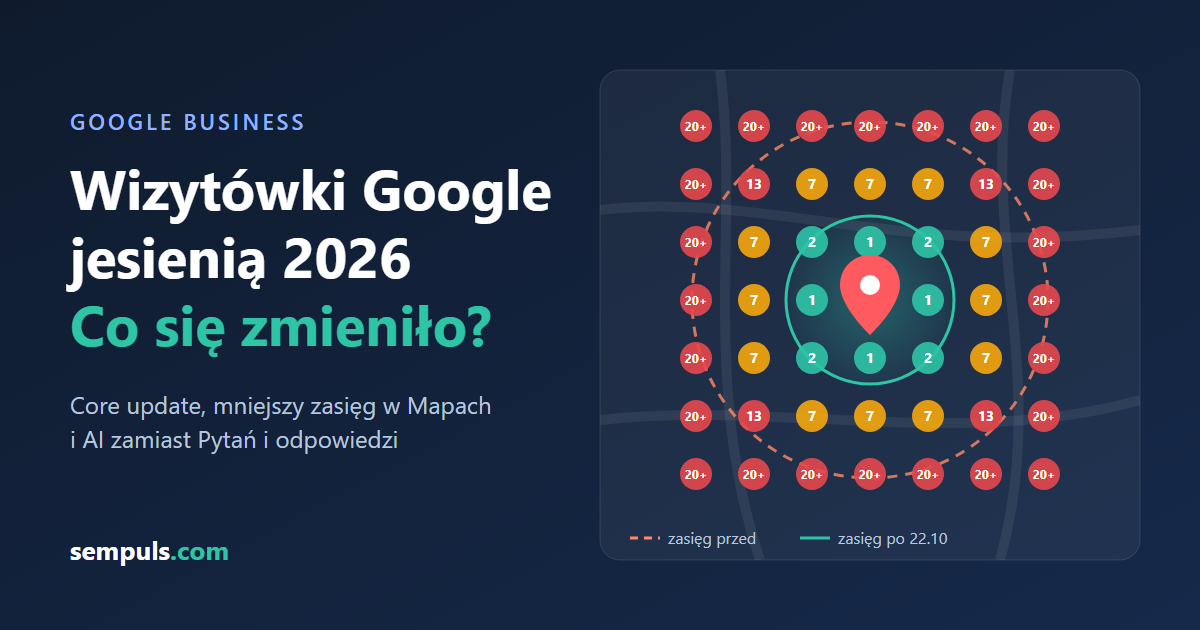
The observation that caused the most discussion comes from late October. One local SEO specialist compared results for 40-50 businesses between 22 and 27 October. In about 85% of cases they saw a similar picture:
- a business that used to rank high within a radius of several kilometres now ranks well only close to its own address,
- businesses with many reviews lost the most, while those with fewer reviews sometimes gained,
- near its office a business could still be first, but its average position across the whole city dropped noticeably. In one of the examples a law firm went from an average position of 2.5 to 16.9.
Two things need to be said here. Google has not announced anything like this, and the data comes from one person. Some experts also point out that Google does not publish announcements about local ranking changes the way it does for core and spam updates. Claims that Google increased the weight of distance in 2026 have no official confirmation.
Distance from the searcher is, however, one of the three local ranking factors that Google lists in its documentation. The other two are relevance and prominence. Since the Vicinity update in 2021, distance has carried a lot of weight in local results.
Changes to the profile itself
Regardless of rankings, Google is rebuilding the Business Profile this year. Industry news sites describe several changes:
- The Questions and answers section is going away. Customer questions are answered by AI using data from the profile and the business website. Google has also tested a new version of this feature.
- An AI agent in messaging. The old chat in the profile has been retired (the date most often given is 31 July 2026). It is being replaced by an AI agent that answers customers based on business data and hands harder cases over to a person. For now only some businesses have access.
- Business Profile in Gemini. Since June 2026 some profile settings can be changed from the Gemini app. There are limits depending on country and account type.
- Collected Info. This is a new section for confirming business details, currently available only in some countries and categories.
- Services added by AI. Google is testing automatic filling of the services list in profiles, so it is worth checking from time to time what has appeared there.
- More ads in local results. The map pack shows sponsored listings, Local Services Ads and AI-built lists of businesses more often. That leaves less room for free listings.
All these changes point the same way. Google increasingly answers customer questions about a business by itself, using the data in the profile and on the website. If the description is short and the services list is incomplete, the answer will be vague and the customer may choose someone else.
Reviews
Several analyses published this year argue that what matters most is how regularly a business gets new reviews, and less how many it has in total. A business with a few new reviews every week would do better than one with several hundred reviews from years ago. Google has not confirmed this, but it fits the October observations, in which businesses with many older reviews lost reach.
There have also been reports that Google is testing a requirement to sign in to a Google account to read all reviews. This has not been confirmed either.
What Sempuls data shows
We checked whether these changes are visible in the Business Profiles we work with in Sempuls. This is the Polish market, mostly local service businesses and online shops.
Reach in Maps has not changed. We compared ranking grids from the last measurement before 22 October with the first measurements after 28 October, at the same points. The average position near the business address did not change, at the edges of the grids the difference was less than a tenth of a position, and the share of points in the top three changed by less than one percentage point. The vast majority of grids did not move by a single position. For now, the observations from the United States do not carry over to the Polish market.
No effect from the core update yet. On the same grids, the first week of the update looks almost the same as the week before it. We will check again once the rollout is complete.
Search impressions fell by more than 80%. Business Profile statistics show a sudden change. Between 23 and 26 September the number of profile impressions in Google Search dropped within a few days to roughly a third, and it kept falling after that. By early November it was more than 80% lower than in mid-September. The drop affects practically every profile with meaningful traffic, regardless of industry or city. Over the same period, impressions in Maps grew by more than ten percent, while the number of calls, website clicks and direction requests stayed at a similar level.
Google has not announced any change in how impressions are counted, so what follows is our interpretation. Since 24 September Google has been blocking bots that scrape search results at scale much more aggressively (we described this in our article on false ranking drops). Some of the earlier search impressions of Business Profiles may have come from such bots rather than from people. The fact that contacts from real customers did not change points in that direction. Birdeye describes a similar pattern over a longer period: between 2023 and 2025 profile impressions fell by 53.8%, while customer actions fell by only about 5%.
If your profile statistics show a large drop in impressions since late September, but you are getting as many calls and direction requests as before, you have most likely not lost customers. It is better to judge a profile by customer actions than by impressions alone.
What to do with your profile now
- Wait until 24 November before judging. While the update is rolling out, fluctuations are normal.
- Check rankings in several parts of the city. A search from your office will usually show the business at the top, even if two kilometres away it is in 15th place. A change in reach only shows up in a measurement taken across a grid of points.
- Compare results from before and after 22 October. If you are still in the top three near your office but your average position across the city has dropped, smaller reach may be the reason.
- Complete your profile. The description, services, categories, opening hours and photos are now the material AI uses to answer customers.
- Ask for reviews regularly. A few new reviews a month will do more than a one-off campaign. Reply to every one of them.
- Take care of your website. The core update evaluates the website, and the profile's prominence depends on it too.
- Check changes made by Google. Services added by AI and edits suggested by users can change what customers see in your profile.
Summary
Only the November core update is confirmed. Smaller reach of Business Profiles in Maps is, for now, an observation by a few specialists, not an announced change, and our data from the Polish market does not show it. What it does show is a large drop in search impressions since late September that did not lead to fewer customer contacts. In the long run something else may matter more: the profile is increasingly used as a data source for AI that answers customers on behalf of the business.
To know whether any of these changes has affected your business, you need to measure your profile's rankings at many points across the city and compare the results over time. In Sempuls this is what the Maps module with its ranking grid is for. It shows where the business is in the top three and where it drops out of the results.
Sources
Core update (November 2026):
- Justia Onward - Google's November 2026 Core Algorithm Update Is Now Rolling Out
- PPC Land - Google's core update shifts rankings for up to 2 weeks before Black Friday
- Redefine Your Marketing - Google Algorithm Update: A Running List
Profile reach and local ranking factors:
- Distribb - Google Maps Proximity Update: What to Do Now
- Searchprex - Local SEO News & Updates 2026: Google Maps & GBP
- Loop Digital - Google's Biggest Local SEO Changes for 2026
- Google Business Profile Help - Tips to improve your local ranking on Google
Impressions and customer actions:
- Birdeye - State of Google Business Profile 2026
- Social Places - The Impression Recession: Local Search Metrics Shift 2026
- Sempuls own data: Maps ranking grids and Google Business Profile statistics of clients in the Polish market, as of 12 November 2026.
Business Profile changes:
- Search Engine Roundtable - Google Business Profiles AI-Powered Messaging Expands
- Search Engine Roundtable - Google Business Profiles Testing Revamped Q&A Feature
- Search Engine Roundtable - Google Business Profiles New Collected Info
- PPC Land - Gemini now manages your Google Business Profile with a single tap
- DAC Group - Google is testing AI-generated Services on Business Profiles
- Socius Marketing - The End of GBP Q&A: How to Optimize Your Business Profile for the AI Era
Some of the changes described here have not been officially confirmed by Google. We point out which ones in the text.
