Since 24 September 2026, Google has been serving some of the bots that check rankings result pages that look normal but have their organic listings swapped out. Anyone who reads a rank report sees the effect: a keyword suddenly falls out of the top 30, even though the site has lost nothing in Google. Here we show what public sources say about this, what Sempuls data showed on 2 November 2026, and how to tell a real drop from a measurement error.
What has been happening to Google results since late September
Rank tracking tools don't sit in front of a browser. They fetch Google result pages automatically, thousands of times a day, and read your domain's position from them. Since 24 September, Google has been recognising these fetches more and more often. Instead of the real result page, it then returns one of two versions:
- a page with swapped results - with ads and an AI summary, but with a different set of pages in the organic results, often without company websites and with aggregators and directories instead,
- a cut-down page - with only a few results or no further pages, so a keyword ranking 15th has nowhere to appear.
The industry calls these poisoned SERPs. Google has made no statement about it. According to AccuRanker, the decision is made for a whole browser session, not for a single keyword, so one poisoned session can spoil many measurements at once.
What public sources say
Several companies that measure rankings themselves have already described the problem. The key data:
- AccuRanker (article from 19 October, updated until 26 October) reports that before the change whole result pages flipped in about 1 in 1,000 checks. On 25 September the share of poisoned desktop pages reached 30%, then fell to 1-3% a day. On 24 October Google poisoned 40% of first fetches, and after checks and refetching the bad ones, 3.2% remained. Google tightened the mechanism again on 15, 20 and 23 October.
- Nozzle, using its own method, showed a peak of 27% poisoned results on 29 September.
- stat4seo described Polish result pages without company websites as early as 6 October.
- DataForSEO, in a notice from 23 October, did not announce a fix, only an extra field for verifying the result.
- cloro, in its comparison up to 31 October, showed that some popular Google results APIs returned a full page in about 10% of attempts, and the best ones in over 95%. The same source reports another change on Google's side on the evening of 26 October.
One conclusion follows from these sources: the problem is real, it affects the whole industry and no tool is immune to it. Tools differ in what they do with a bad result.
What we see in Sempuls data
Sempuls measures around 900 client keywords on the Polish market every day. This shows how big the problem is in Polish results, which foreign reports barely cover.
Fewer hits in the first measurement
Before 24 September, the nightly measurement found the client's domain in the results for about 890 keywords. By mid-October it was only about 550, even though client sites were not losing traffic from Google. At the turn of October and November, 52-61% of keywords that had been in the top 10 the day before disappeared from the results in the first measurement. That is far more than the few percent reported by trackers that reject poisoned pages themselves.
A second check is no longer enough
We check every lost keyword again with a different tool. Between 20 and 26 October, this recheck recovered about 60% of keywords. After the change on 26 October, its success rate dropped to 20-25%. This matches the moment other companies reported another tightening on Google's side.
A test of 266 lost keywords
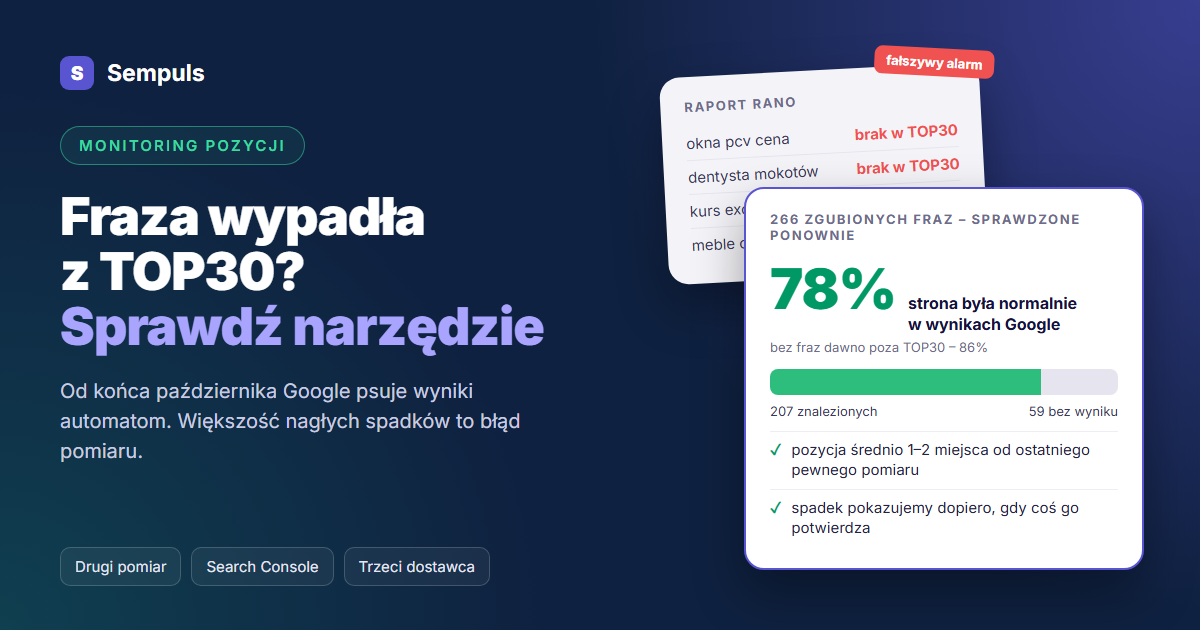
On 2 November we took all keywords from that day that two measurement tools had failed to find and checked them with a third provider. The result:
- in 78% of cases the client's site was in Google's results as usual,
- excluding keywords that had already been far outside the top 30, in 86%,
- positions differed from the last reliable measurement by 1-2 places on average.
So most of that day's drops were measurement errors, not problems with the site.
How much Google Search Console data is worth
Search Console is not poisoned, because it shows positions from real impressions. It has two limits, though. Data arrives with a 2-3 day delay, and for keywords the site got no impressions for, there is no data at all. We checked how accurate different ways of filling the gaps are, comparing each with the next real measurement:
- the last reliable position confirmed by impressions in Search Console - 72% within two places,
- carrying over the last reliable position without confirmation - 71%,
- the average position from Search Console alone - only 35%.
Search Console is good at confirming that a site is still in the results. As a standalone source of the exact position it performs poorly, because an average of a few impressions can be off by several places.
How to spot a false ranking drop
Before you start fixing your site after a drop in a report, check a few things:
- Does the drop affect a single day? According to AccuRanker, more than 9 in 10 poisoned results for a keyword last one day. If the keyword is back the next day, it was a measurement error.
- Did many keywords disappear at once? A sudden drop of dozens of keywords on one day, with no change to the site, is the typical picture of poisoned results.
- Did your competitors disappear with you? If the saved results are also missing pages that usually sit next to yours, suspect the data, not the site.
- What does Search Console say? Filter by keyword and date. If the average position and the number of clicks did not change, the drop in the tool was false.
- Are there businesses from another town in the local results? This is a common sign of a swapped result page.
Don't react to a single day. Base decisions about changes to your site on the trend across several measurements.
What we do at Sempuls
Since early October, rank monitoring in Sempuls has had a separate path for days when measurement is disrupted:
- Rechecking lost keywords with a different tool, in a different session and at a different time.
- Comparison with Google Search Console. If the site has impressions and the last reliable measurement was recent, we show that position as filled in, not as a drop.
- Clear labels in the rank calendar. Disrupted days and filled-in positions are marked, so you know what is a measurement and what is an estimate.
- Testing an additional results provider. Following the results from 2 November, we are testing a source that found most of the lost keywords in our test.
We are also working on a check before a measurement is saved. If the new top 10 for a keyword shares fewer than half of its pages with recent days, the result will be fetched again before it reaches the report. AccuRanker describes this approach. According to their data, a single refetch returns a normal result in roughly 3 out of 4 cases, and further attempts and checks bring the share of bad results down to a few percent.
Summary
Since 24 September 2026, Google has been deliberately making automated rank checking harder, and since 26 October it has been doing so even more effectively. In Sempuls data from the Polish market, most sudden drops are measurement errors. In the test from 2 November, 78-86% of lost keywords were in the results as usual. Don't draw conclusions from a single day, check Search Console, and use a tool that verifies suspicious drops itself before showing them in a report.
